


A sense of feeling of anticipation. I can see the chilled vapour exhaled by my competitors as they perform the "about to run" wiggle on the beginning point.
A rapid movement of the hips.
I'm lined up for my local 5km community parkrun and I'm serious. The countdown begins...
Oh, hang on. I have to start my tracker. So does the guy alongside me.
The person in the line expresses impatience. I won't start until… yes! Signal acquired, I'm off.
During the scramble, it's difficult to spot a person without a fitness tracker on it. And it's not just us athletes who wear them.
It's a explosive, multi-billion dollar industry. Names like Samsung Galaxy dominate, each with an extensive selection of different models to fit a variety of needs. Based on how feature-packed the watch you go for, prices can start from a hundred pounds to a small fortune.
"I find it infuriating, I can't stop checking."
"It reassures me… It feels like a companion encouraging me."
"Please don't notify me I've had a restless night."
A small sample of the comments people have shared from fellow tracker enthusiasts when I question what they their opinion is on theirs.
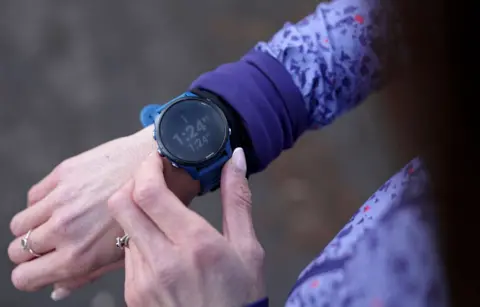
A Sea of Statistics
My current opinion on my own device? Right now, frustrating. It's telling me my speed is wrong, making me wonder whether the foliage I'm running below are disrupting my GPS connection.
Millions of us strap these little devices onto our arms and wear them constantly, ostensibly comfortable with the fact they're continuously tracking us.
Long past are the days when we depended on them solely to give us an rough count of our step count. Today, they can track our sleep quality, stress levels, oxygen saturation, our recovery score.
It's tricky to find a bodily function they don't track.
But do they do what they advertise? And are the statistics we scrutinise a true reflection of the truth? Do they boost our daily wellness, or do the plethora of metrics and constant notifications just increase our everyday anxiety?

A Complicated Bond
"I find myself getting a a little obsessed with mine," one user admits.
While she appreciates how her device tracks her workouts, she finds some of its other features "overwhelming" at times - a feeling first discovered during a major life event.
Before she realised she could adjust the settings, her smartwatch repeatedly informed her she was not being productive enough. Now, the watch insists her she's had a restless night.
"I have a young baby, I don't need to be told my sleep was poor," she says. "I know that all too clearly."
Why doesn't she just take it off?
"It's possible, I suppose, but I've got this love-hate relationship with it," she explains. "I value it for its fitness insights, I just wonder whether all the other things it can now do is possibly too much for me."
How Do They Work?
Different brands of smartwatch has its own unique way of tracking your health metrics and interpreting your data, but the vast bulk use detectors on the underside of the watch.
They commonly emit minute LED lights onto your skin which can monitor capillary action, recording your heartbeat. Higher-end devices detect changes in the bioimpedance that passes over the skin to gauge your recovery state.
Expert Perspectives
A data scientist says that for most people for smartwatches, it's a "delicate equilibrium" - while the continuously improving tech could potentially prevent illness, "identifying issues before we notice anything", it could also turn us device users into the "worried well".
He points out that the most advanced wearables can conduct tests like heart rhythm analysis, which continuously monitor how normal the heart is. They can alert if someone is experiencing an irregular rhythm, where there is abnormal electrical activity in the heart causing an arrhythmia.
This does not necessarily indicate someone is about to have a cardiac event, but it can give an advance notice they might be more at risk of a stroke in the future.
But how to make sense of these numbers is complicated. The expert concerns that as more functions are incorporated, people may not be able to fully comprehend their data.
"I have some doubts that being able to monitor so many metrics is such a good idea," he says.
A clinical psychologist studying patient behaviour concurs. A study into the impact of wearable tech on a specific group of individuals with health issues suggested a significant portion of those who were given devices to monitor their heart health experienced heightened worry and were "far more likely to use healthcare resources".
She observed a cycle with her patients - they noticed a alarming metric on their watch. They felt anxious. Their pulse went up. They got even more concerned. They re-examined the data, and their anxiety rose further.
"Upon viewing data about ourselves that we don't really understand then, of course, we are going to want to know more," the psychologist says. "We look, we check again - it becomes a vicious cycle."
